
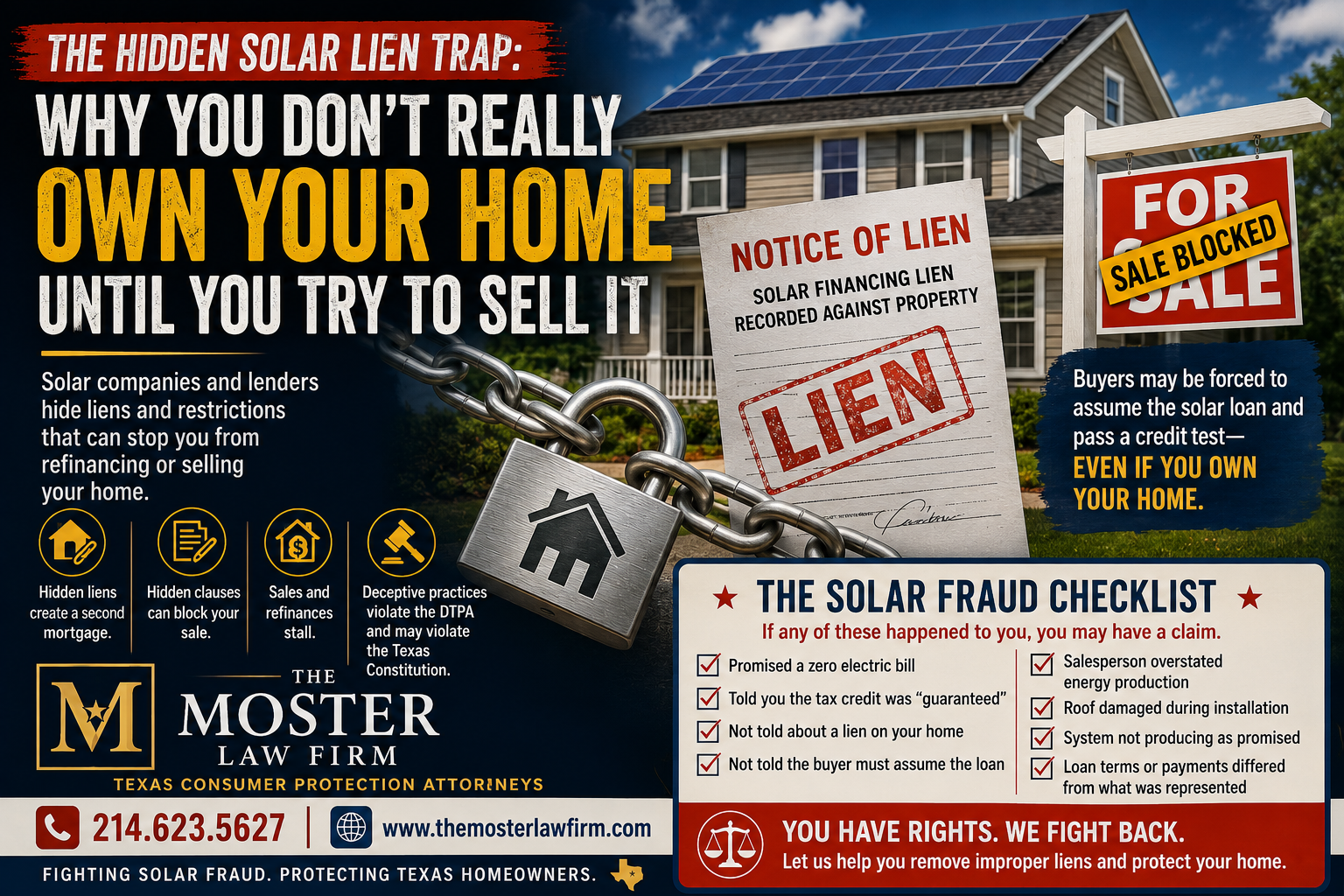
The Hidden Solar Lien Trap: Why Thousands of Texas Homeowners Discover They Don’t Really Own Their Home Until They Try to Sell It
“Congratulations on your new solar system.”
Those words have become the beginning of a financial nightmare for many Texas homeowners.
The sales representative promised lower electric bills. They promised energy independence. They promised valuable tax incentives. They promised that solar panels would increase the value of the home.
What they did not explain is often far more important.
Months or even years later, homeowners call our office in a panic. “I’ve accepted an offer on my home.”
“My refinance just fell apart.”
“My real estate broker says there is a lien on my house.” “I never agreed to this.”
Unfortunately, by the time they discover the truth, the damage has already been done.
The Hidden Solar Lien
Many consumers are shocked to learn that the solar financing documents frequently allow the lender to record a lien or security interest affecting the property.
The lien often goes unnoticed because the homeowner is never clearly told what it means in practical terms.
Everything seems fine—until they try to refinance their mortgage or sell their home. Then the title company discovers the problem.
The lender wants to be paid. The sale stalls.
The refinance dies.
The homeowner is trapped.
Your House Suddenly Has Two Major Debts
Most homeowners assume they have one major obligation secured by their home—their mortgage. Then comes the surprise.
The solar financing creates an additional obligation that must frequently be addressed before closing.
A buyer who planned to purchase the home now learns that a significant solar obligation must somehow be resolved.
Many simply walk away.
Others demand large price reductions.
Transactions collapse every week because buyers understandably do not want to inherit someone else’s solar financing.
The Hidden Clause That Can Kill Your Home Sale
Perhaps even more disturbing are contractual provisions buried deep within lengthy financing agreements. Many homeowners never realize they have agreed that they cannot simply sell their house.
Instead, the purchaser may be required to:
- Assume the solar financing;
- Meet the lender’s underwriting standards;
- Pass a credit review;
- Execute additional financing documents; and
- Obtain lender approval before the sale can close.
Think about that.
You may own your home.
You may have found a willing buyer.
You may have negotiated an acceptable price.
Yet a solar finance company—one you never expected to control the transaction—can effectively stand between you and the closing table.
Few homeowners are ever told this during the sales presentation.
“This Was Never Explained to Me.”
We hear those words constantly.
Consumers describe high-pressure sales presentations lasting hours. Representatives focus on electric savings.
They discuss federal tax credits. They promise increased home value.
Yet many homeowners tell us they were never clearly informed that:
- selling the home could become substantially more difficult;
- refinancing could be jeopardized;
- future purchasers might have to qualify for the solar financing;
- additional liens or security interests could affect title; or
- the solar financing could become one of the largest obstacles to selling their home.
When these material facts are omitted—or worse, contradicted by sales promises—the issue may extend well beyond simple breach of contract.
Texas Law Protects Consumers From Deceptive Practices
The Texas Deceptive Trade Practices Act (“DTPA”) prohibits false, misleading, and deceptive acts occurring in consumer transactions.
A solar salesperson who represents that solar financing will have no meaningful impact on the homeowner’s ability to sell or refinance, while failing to disclose significant restrictions buried in financing documents, may expose both the seller and financing company to substantial liability.
The DTPA was enacted precisely because consumers often lack equal bargaining power and do not have lawyers sitting beside them during high-pressure sales presentations.
When material facts are concealed, omitted, or misrepresented, Texas law provides powerful remedies.
Depending upon the facts, homeowners may recover economic damages, attorney’s fees, and, where the conduct is committed knowingly or intentionally, additional damages authorized under the DTPA.
A Serious Constitutional Question
Texas homeowners also enjoy unique constitutional protections.
Article XVI, Section 50 of the Texas Constitution contains some of the strongest homestead protections in the nation by placing strict limits on the types of liens that may attach to a Texas homestead.
Those constitutional protections have existed for generations to prevent homeowners from unknowingly placing their homes at risk.
Whether a particular solar financing arrangement or recorded lien complies with those constitutional requirements depends upon the specific documents, the structure of the transaction, and the applicable law.
In appropriate cases, homeowners should carefully evaluate whether the lien was legally authorized and enforceable under Texas constitutional homestead protections.
We Aggressively Challenge These Transactions
Our Firm has represented numerous Texas homeowners involving deceptive solar sales practices. Every case is different, but our objectives frequently include pursuing relief such as:
- cancellation of deceptive solar obligations where legally appropriate;
- removal of improper liens affecting the property;
- elimination of restrictions preventing the homeowner from selling the home;
- recovery of attorney’s fees under the DTPA;
- compensation for financial losses caused by deceptive conduct; and
- obtaining a resolution that allows the homeowner to move forward without being trapped by an undisclosed solar obligation.
Many homeowners assume they have no options once they sign. That is simply not true.
Texas consumer protection laws exist for a reason.
Don’t Wait Until Closing Day
The worst time to discover a hidden solar lien is after your house is under contract.
If you are considering selling your home, refinancing, or have recently discovered that your solar financing has placed unexpected restrictions on your property, have the documents reviewed immediately.
The sooner these issues are identified, the greater the opportunity to protect your rights before a transaction collapses.
At The Moster Law Firm, we continue to investigate deceptive solar financing practices throughout Texas. If you believe important facts about your solar financing were hidden or misrepresented, you may have significant legal rights under Texas law.
Don’t let a hidden solar lien become the surprise that costs you your home sale.