Solar Company Went Out of Business?
NO PROBLEM!
“My solar company closed its doors. Does that mean I’m stuck with a defective system and a huge loan?”
Absolutely not.
This is one of the biggest misconceptions we hear from homeowners. Many people assume that if the solar installer files bankruptcy or simply disappears, there is nothing that can be done.
The law says otherwise.
The Salespeople and Company Owners May Still Be Personally Liable
In many Texas solar fraud cases, homeowners were promised things that simply were not true:
- “Your electric bill will disappear.”
- “The system will pay for itself.”
- “The tax credit is guaranteed.”
- “Your home value will increase immediately.”
- “This is a government-backed program.”
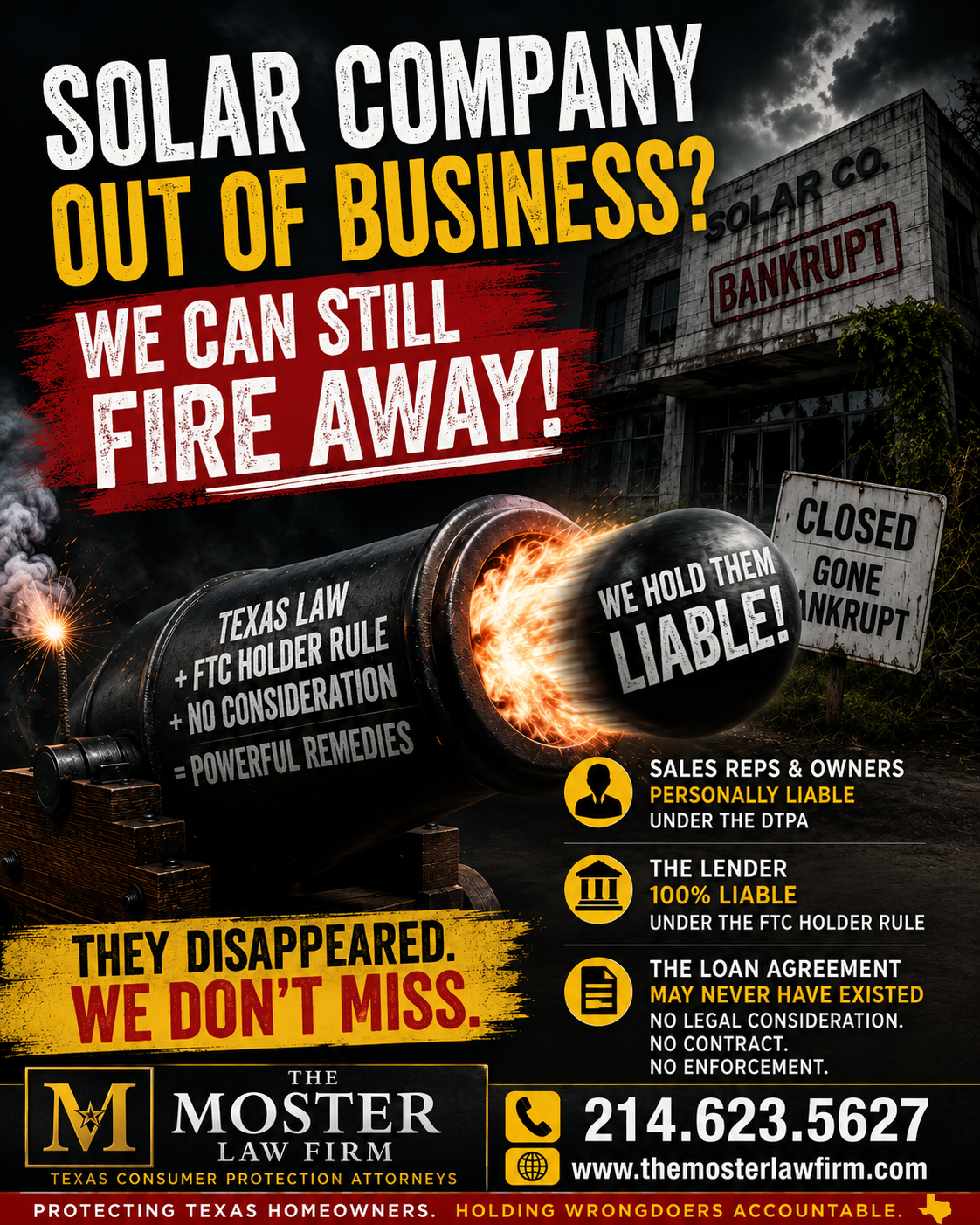
If those statements were false or deceptive, the individuals who made them—and, in many cases, the people running the company—may still be personally liable under the Texas Deceptive Trade Practices Act (DTPA).
A company filing bankruptcy does not automatically erase the liability of individuals who committed or directed deceptive conduct.
The Lender Is Often Responsible Too
Here is the part that surprises almost everyone.
The finance company that made the solar loan can often be held responsible for the same fraud committed by the solar seller.
Why?
Because of a federal law known as the FTC Holder Rule.
Even if the lender never attended the sales presentation, never knocked on your door, and never made a single promise to you, the law may still allow homeowners to assert the same claims and defenses against the lender that they have against the solar company.
That can be a powerful tool.
The Loan Itself May Not Be Enforceable
In some cases, the problem goes even deeper.
Texas law may allow homeowners to argue that the loan agreement was never legally formed in the first place.
How can that be?
Every valid contract requires what lawyers call consideration—each side must actually receive the legal benefit that formed the basis of the agreement.
If the promised solar system, savings, or performance that induced the transaction was fundamentally different from what was actually delivered, there may be a legal argument that the required consideration never existed.
This is an important distinction.
Rather than simply arguing that a contract should be canceled because of fraud, the law may recognize that no enforceable contract was ever created in the first place because one of the essential building blocks of contract formation was missing.
That can completely change the legal landscape.
Don’t Assume Bankruptcy Ends Your Case
When a solar company disappears, many homeowners stop fighting because they believe the case is over.
In reality, that is often when the investigation should begin.
Potential claims may still exist against:
- The individuals responsible for the deceptive sales practices.
- Company owners or officers who participated in the misconduct.
- The finance company under the FTC Holder Rule.
- Other parties involved in the transaction, depending on the facts.
Every case is different, but homeowners frequently have far more legal options than they realize.
At The Moster Law Firm, we represent Texas homeowners in solar fraud and deceptive trade practice cases. If your solar company has gone out of business, don’t assume your rights disappeared with it.
They may just be getting started.