
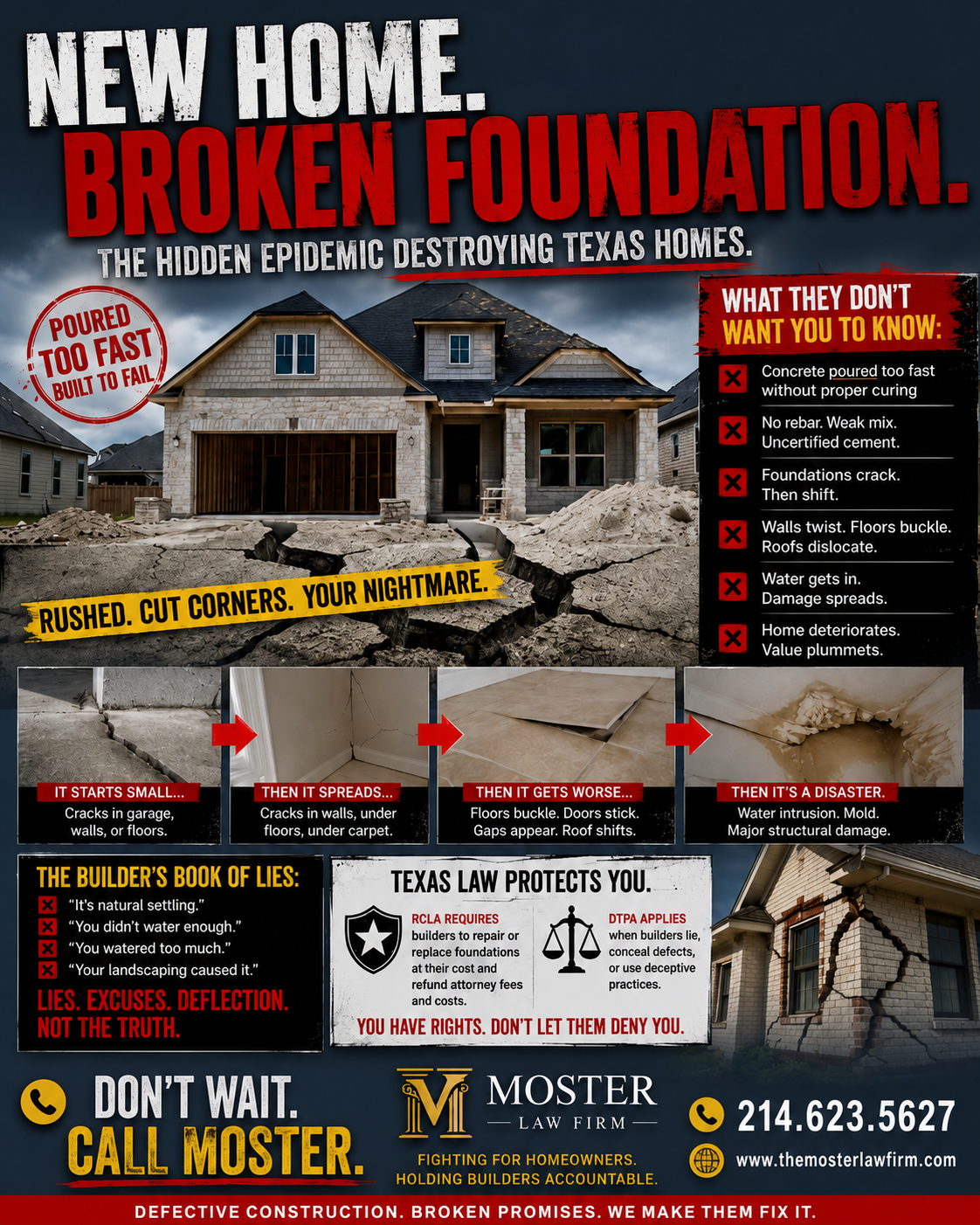
Why Is There an Epidemic of Foundation Problems in New Homes?
Drive through almost any new subdivision in Texas and you’ll see the same scene repeated over and over. Concrete slabs are being poured one after another at a breathtaking pace. Before long, framing crews arrive, walls go up, roofs are installed, and another home is ready for sale.
The speed is impressive.
Unfortunately, in too many cases, speed comes at a price.
At The Moster Law Firm, we have represented homeowners across Texas whose “dream homes” began showing signs of serious structural distress only months or a few years after closing. While every case is different, many of these homes exhibit remarkably similar patterns of failure.
Building Too Fast
A properly constructed foundation is the backbone of every home. Everything that follows—the walls, floors, roof, plumbing, windows, and doors—depends upon that foundation remaining stable.
Yet production builders often operate under enormous pressure to build homes as quickly as possible. Entire neighborhoods appear almost overnight. It is not unusual to drive past a development and see slab after slab being poured like an assembly line.
When construction schedules become more important than construction quality, problems can develop.
Among the issues our experts frequently investigate are:
- Improper site preparation or soil stabilization.
- Inadequate reinforcement or improperly installed rebar.
- Concrete that allegedly fails to meet required specifications or quality standards.
- Improper concrete placement or finishing.
- Failure to follow engineering plans.
- Construction sequencing that prioritizes speed over long-term performance.
Every case requires expert engineering analysis, but one fact remains constant: if the foundation is compromised, the rest of the house is at risk.
The Domino Effect
Foundation movement rarely stays confined to the slab itself.
Once the foundation begins to shift, settle unevenly, rotate, or experience differential movement, the entire structure begins reacting to those forces.
Homeowners often notice:
- Cracks in the garage floor.
- Cracks appearing around doors and windows.
- Interior sheetrock cracks.
- Doors and windows that suddenly stick.
- Separation at ceilings or corners.
- Tile floors cracking or tenting.
- Hardwood or laminate flooring buckling.
- Gaps beneath flooring or carpeting.
- Roof components moving out of alignment.
- Water intrusion around windows, walls, or the roof.
What begins as “just a crack” can evolve into widespread structural damage affecting nearly every major system in the home.
The Same Explanations Again and Again
After handling numerous construction defect cases, one pattern appears repeatedly.
Many homeowners report being told that the cracking is simply:
- “Normal settling.”
- “Cosmetic.”
- “Within industry tolerances.”
- “You watered your foundation too much.”
- “You didn’t water enough.”
- “Your landscaping caused the movement.”
- “Texas soils always move.”
Certainly, expansive soils can contribute to foundation movement, and homeowner maintenance can matter in some situations.
But these explanations should never substitute for a thorough, independent structural investigation when significant cracking or movement is occurring.
Too often, homeowners are reassured without anyone identifying the true underlying cause.
Beware of Conflicts of Interest
Another issue we frequently encounter is the builder recommending or arranging for its own structural engineer to inspect the home.
While many engineers perform their work with complete professionalism and integrity, homeowners should recognize the obvious concern when the party accused of defective construction selects the professional evaluating that construction.
When substantial structural damage exists, homeowners should strongly consider obtaining an independent engineering evaluation from an expert whose loyalty is to the facts—not to the builder.
The Cost Keeps Growing
Foundation movement rarely improves by itself.
As the structure continues to move, repair costs often increase dramatically.
Small cracks can become major structural failures.
Doors may no longer function.
Floors may require replacement.
Roof systems can become displaced.
Water intrusion can lead to mold and interior damage.
Most importantly, the home’s fair market value may decline substantially, leaving families with an asset worth far less than they paid.
Texas Law Protects Homeowners
Texas law provides important protections for homeowners facing serious construction defects.
Under the Texas Residential Construction Liability Act (RCLA), builders generally must be given an opportunity to inspect and repair qualifying construction defects. Depending upon the circumstances, homeowners may also recover reasonable attorney’s fees and litigation costs as authorized by the statute.
Where the evidence shows that a builder or seller knowingly concealed defects, made false representations, or engaged in deceptive practices, additional remedies may exist under the Texas Deceptive Trade Practices Act (DTPA). In appropriate cases, these claims can significantly expand the damages available to homeowners.
Every case is different, and the available remedies depend upon the specific facts.
Don’t Accept the First Answer
If your new home has begun developing cracks, foundation movement, uneven floors, sticking doors, roof displacement, or unexplained water intrusion, don’t assume it is merely “normal settling.”
The sooner an experienced construction defect attorney and qualified independent experts evaluate the problem, the greater the opportunity to identify the true cause before additional damage occurs.
At The Moster Law Firm, we have extensive experience representing Texas homeowners in complex construction defect litigation involving foundations, water intrusion, structural failures, and deceptive construction practices.
If you believe your builder has failed to construct your home properly—or has failed to tell you the truth about serious defects—contact us for a confidential consultation. We can help determine your rights under the RCLA, the DTPA, and other applicable Texas laws, and fight to obtain the repairs and compensation you deserve.