In our experience, landlords too often take advantage of commercial tenants who do not have an aggressive advocate behind them.
Repairs are delayed. Promised improvements remain unfinished. Costs are pushed onto the tenant. Meanwhile, the landlord continues demanding rent. The Moster Law Firm believes tenants need an advocate prepared to challenge that conduct, enforce their rights, and pursue the full relief the law allows.
You signed the lease, invested in improvements, purchased equipment, and opened your doors. Your customers, patients, or clients know where to find you. Your employees depend on the business. You expect the building to support the work you do every day.
Then the problems begin.
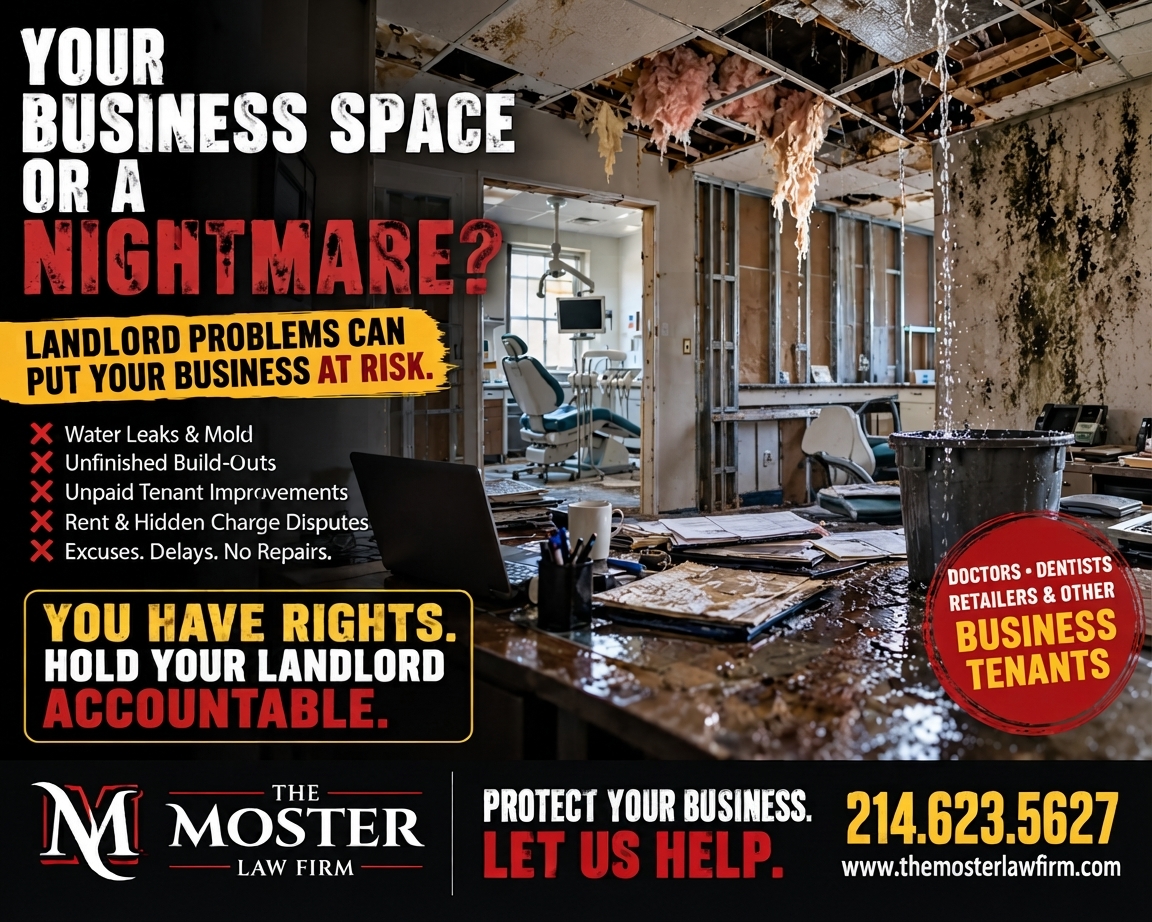
Water leaks into the office whenever it rains. Mold is discovered behind a wall. The air conditioning repeatedly fails. The landlord has not finished the promised improvements. Or unexpected charges appear on the rent statement while your complaints go unanswered.
A commercial landlord dispute can threaten the operation of an entire business.
These problems affect doctors, dentists, and other professional practices, as well as retailers, restaurants, salons, fitness studios, franchise operators, office tenants, and businesses leasing warehouse or industrial space. A commercial tenant cannot always close its doors, pack up, and move without substantial expense and disruption.
The Moster Law Firm helps Texas businesses address construction problems and commercial disputes. When the problems involve leased space, the goal is to determine what went wrong, who is responsible, and what can be done to protect the business.
Your Location Is Part of Your Business
A medical or dental office may represent years of planning and a substantial financial investment. Treatment rooms, specialized plumbing, electrical systems, cabinetry, imaging equipment, and other improvements are designed around the space.
When that space becomes unusable, the consequences reach beyond a repair bill. Patients may need to be rescheduled. Employees may be unable to work. Equipment may be damaged. A delayed opening can leave a practice paying rent, payroll, and financing costs before it can see its first patient.
A restaurant depends on its kitchen, ventilation, plumbing, and customer access. A retailer may have inventory and displays exposed to water damage. A salon relies on working plumbing and electrical systems. A warehouse tenant needs space where goods can be stored and handled without recurring leaks or disruption.
Whatever the business, a building problem can quickly become an income problem.
Water Infiltration and Mold in Leased Commercial Space
Recurring roof leaks, defective windows, plumbing failures, drainage problems, and water entering through walls or foundations can damage a commercial property and everything inside it.
Moisture may collect behind walls, beneath flooring, or above ceilings before the tenant understands the extent of the problem. Mold, sewage backups, persistent odors, and other environmental concerns may require qualified professionals to investigate the conditions and determine appropriate corrective work.
For doctors and dentists, the affected areas may include examination rooms, dental operatories, waiting areas, records storage, and expensive equipment. Other tenants may face damage to merchandise, food preparation areas, workspaces, furnishings, or stored materials.
The underlying cause needs attention. Repeatedly replacing ceiling tiles will not correct a roof that continues to leak.
A meaningful investigation should address how the water entered, what materials were affected, whether contamination is present, and what work is needed. The lease and the evidence must then be examined to determine the landlord’s responsibility and whether contractors or other parties may also be accountable.
The Problems You Were Never Told About
Some tenants discover that the building had a history of problems long before they signed the lease.
The roof may have leaked repeatedly. Previous occupants may have complained about odors or moisture. Repairs may have concealed visible damage without correcting its source. Yet the space was presented as ready for occupancy.
What the landlord knew, what was represented, and what was left undisclosed can become important. A business that invested in a location based on misleading assurances may have legal options, depending on the facts and the lease.
Save the emails, text messages, leasing materials, inspection reports, and photographs. Those records can help establish what you were promised and how the actual condition of the property differed.
When the Build Out Goes Wrong
A landlord may promise to deliver a finished office by a particular date. Instead, the work drags on, the layout does not match the approved plans, or the contractor installs systems that do not meet the practice’s needs.
Disputes can involve incomplete work, defective construction, missing permits, disputed change orders, unexpected costs, and disagreements over who must correct the problems.
For a doctor or dentist, an office can look finished and still be unsuitable for opening. The plumbing, power supply, ventilation, or equipment installation may remain incomplete. A restaurant, salon, gym, or retail store may face similar delays when essential work has not been completed.
The date rent begins and the date your business can actually open may be very different.
The lease, construction agreements, approved plans, and written promises should be reviewed together. They help establish what each party agreed to provide and what options may be available when those commitments are not met.
Tenant Improvements and Promised Reimbursements
Many commercial leases include an allowance for tenant improvements. A business may pay contractors and suppliers expecting the landlord to reimburse an agreed portion of the cost.
Problems arise when payment is delayed, the landlord disputes previously approved work, or new conditions are raised after the tenant has already spent the money.
There may also be disagreements over who owns installed improvements, whether equipment can be removed, and what the tenant must restore when the lease ends. For a dental practice, restaurant, salon, or other business with extensive custom installations, these questions can involve substantial sums.
Rent Disputes and Unexpected Charges
A commercial lease often requires payments beyond the monthly base rent. Property taxes, insurance, maintenance expenses, management fees, and common area charges can significantly increase occupancy costs.
Tenants may receive unexplained increases, charges for work they believe is the landlord’s responsibility, or bills that do not appear to match the lease. Others may be denied promised rent credits or charged rent while a dispute over delivery of the space remains unresolved.
These charges deserve a careful review. The lease, billing records, supporting expenses, and deadlines for challenging an assessment can all matter.
Other problems involve parking, signage, deliveries, access to the building, elevators, utilities, and air conditioning outside normal business hours. These services can be essential to a tenant’s daily operations.
The Financial Impact Can Extend Beyond Repairs
A serious landlord dispute may involve damaged equipment, interrupted operations, temporary space, moving expenses, and the cost of rebuilding a specialized office elsewhere.
A tenant may also face continuing rent demands or a claim against an owner who signed a personal guarantee. Renewal deadlines, restrictions on selling the business or transferring the lease, and obligations at the end of the lease can create additional exposure.
The full financial picture should be evaluated. The cost of correcting the building problem may be only one part of the tenant’s loss.
Remedies Available to Commercial Tenants
A tenant’s options may go well beyond another request for repairs. Depending on the lease, the facts, and applicable law, we evaluate claims and remedies that can address both the property problem and the financial harm it caused.
Breach of contract. A landlord’s failure to perform promised repairs, deliver agreed improvements, pay an improvement allowance, or provide required services may support a claim for breach of contract. Available relief can include payment of amounts owed and compensation for losses caused by the breach.
Damages for delay. An unfinished build out or failure to deliver usable space can postpone opening and interrupt operations. Recoverable losses may include reasonably proven lost profits and additional expenses attributable to the delay, such as temporary space, storage, or added carrying costs. We examine the records needed to establish those losses and the lease provisions that may affect recovery.
Health and safety code violations. Sewage problems, unsafe building conditions, and other violations can interfere with a tenant’s ability to operate. Inspection findings, citations, and closure orders may provide important evidence. We evaluate the landlord’s obligations, appropriate requests for enforcement by public authorities, and claims for resulting losses. A code violation does not automatically create a private right to damages.
Fraudulent inducement. When a landlord uses false statements or actionable concealment to induce a tenant to sign a lease, the tenant may have a fraud claim. Examples may involve concealed recurring leaks or knowingly false assurances about the property’s condition. Depending on the evidence and governing law, remedies may include damages or rescission, which seeks to undo the transaction.
Repair costs and other financial losses. Claims may address damaged equipment or inventory, unpaid improvement allowances, remediation expenses, relocation costs, and improper charges. Applicable warranty claims may also be important when the space is unsuitable for its intended commercial use.
Lease relief and court orders. In an appropriate case, a tenant may pursue termination, rescission, or an injunction to address unlawful interference with its rights. Rent credits, corrective work, and other terms may also be negotiated. Attorney’s fees may be recoverable when authorized by the lease or applicable law.
Each remedy requires a legal and factual basis. Lost profits must be established with reasonable certainty; consequential losses must satisfy applicable foreseeability requirements. Lease limitations and the duty to reduce avoidable losses can affect recovery.
Our objective is to identify the full harm, build the evidence, and aggressively pursue every remedy the client is legally entitled to seek.
Protect Your Business Before Taking the Next Step
When a landlord stops responding, the temptation may be to withhold rent, hire a contractor and deduct the bill, or move out immediately. Those decisions can create additional problems if they are made without reviewing the lease and available legal remedies.
Document the conditions. Keep a record of complaints and repair attempts. Preserve invoices and evidence of business disruption. Address immediate safety concerns with appropriate professionals, and obtain legal advice about the required notices and next steps.
You do not have to wait until your business is forced to close before seeking help.
The Moster Law Firm Can Help
Commercial lease problems often combine building defects, financial losses, and disagreements over contractual obligations. Resolving them requires understanding how the property problem is affecting the business.
The Moster Law Firm can review the lease and related agreements, evaluate the landlord’s obligations, and work with appropriate professionals when technical investigation is needed. We can help document the problem and pursue available remedies through negotiation or litigation.
If undisclosed defects, water infiltration, mold, environmental concerns, build out disputes, unpaid improvement allowances, or rent demands are affecting your business or professional practice, contact The Moster Law Firm to discuss your options.
You have invested too much in your business to let an unresolved landlord problem put its future at risk.
This article provides general information about Texas law. The rights and remedies available in a particular dispute depend on the lease and the facts.