
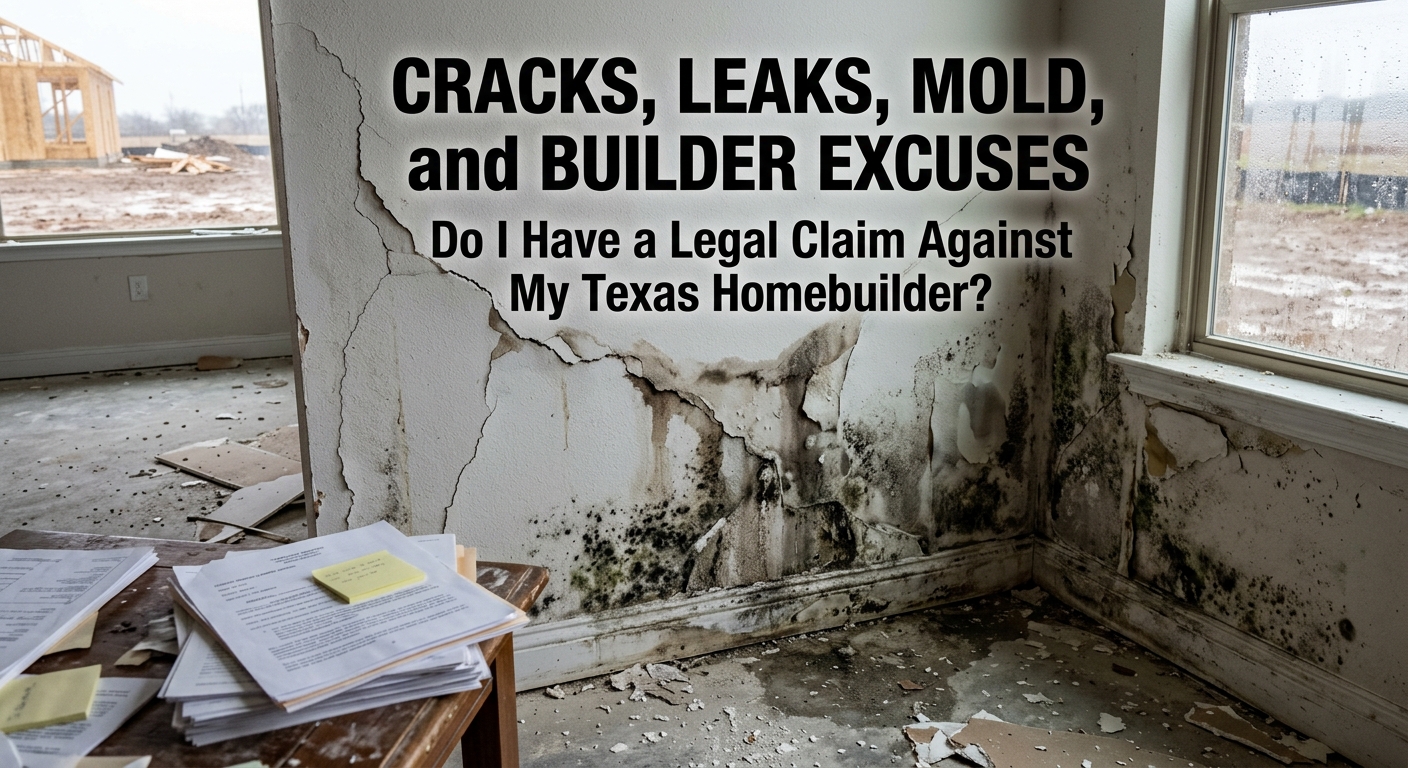
Cracks, Leaks, Mold, and Builder Excuses
Do I Have a Legal Claim Against My Texas Homebuilder?
By Charles Moster, Esq. | Texas homeowner questions and answers | October 13, 2026
A leaking roof, recurring cracks, or a failing foundation deserves a serious answer. If your builder keeps postponing repairs, covering up symptoms, or saying the warranty excludes everything, it may be time to take legal action. These answers explain what to investigate, what relief may be available, and how to protect a Texas residential construction claim.
1. Do I have a legal claim against my residential builder in Texas?
You may have a claim if defective design, construction, or repairs caused damage to your home, left a building component unable to function properly, or created a verifiable safety danger.
At The Moster Law Firm, we examine the contract, construction history, physical condition, repair attempts, and communications to determine whether the facts support a claim and what it will take to prove it.
2. What problems can qualify as residential construction defects?
Residential defects can arise in a new home, an addition, remodeling, or repair work. Common problems worth investigating include:
- Water infiltration through windows, doors, exterior walls, balconies, or improperly installed flashing.
- Cracks in walls, ceilings, brick, tile, or concrete that widen, recur, or accompany other signs of movement.
- Foundation movement, sloping floors, separating walls, and doors or windows that no longer operate properly.
- Mold or concealed moisture damage associated with leaks, drainage failures, or improperly installed building systems.
- Roof leaks, defective underlayment, faulty flashing, and recurring water stains.
- Drainage or grading problems, plumbing leaks, defective framing, and electrical or HVAC installation failures.
3. My builder says the cracks are normal settling. Should I accept that?
No! Ask for the evidence supporting that conclusion. Builders will blame anyone and everything except themselves including so-called “natural settling” which almost never explains the cracks and failure observed. Other excuses are weather, not watering enough, watering too much, trees near the home, etc. We call it the “Contractor Book of Lies” for a good reason.
Photograph changes over time. Record sticking doors, floor movement, leaks, and previous patching. Painting over a recurring crack does not explain why it keeps returning.
4. Can water infiltration or mold support a claim against my builder?
Yes, when the evidence establishes a construction defect and the necessary connection to the damage. Investigate how moisture entered, which components failed, and what work will stop it.
Preserve leak videos, weather dates, moisture assessments, repair invoices, and photographs taken before walls or ceilings are opened. A proposed repair should address both the moisture source and affected materials. Painting a stain or replacing wet drywall may leave the underlying problem untouched. Under state law, the builder is responsible for the full cost of remediation, new contracting work, relocation, and the costs of the mold lab test before and after. Mold will not only destroy the value of your home but can cause serious and potentially life-threatening medical issues.
5. The builder says my problem is not covered by the warranty. Is my claim over?
No. We hear this all the time and your claim is not over – the contractor is trying to walk away from liability!
A warranty denial is the builder’s position, not a court ruling. The denial may overlook the contract, an applicable warranty, or a separate claim involving deceptive conduct. Critically, Texas law supersedes restrictions on repair/replacement of defects. An experienced construction attorney can explain how this works.
We ask the builder to identify the exact exclusion and explain why it applies. We also review what was promised, when the defect appeared, and whether previous repairs actually worked. Do not abandon a potentially valid claim merely because someone in the warranty department said “not covered.”
6. What if the builder ignores me or keeps giving me the runaround?
Happens all the time! Stop relying on an open-ended series of calls and promises. Create a dated record of each complaint, response, inspection, missed appointment, and attempted repair. Save messages saying the problem is normal, already fixed, or someone else’s responsibility.
The Firm can turn that history into a documented demand supported by the contract and available evidence.
7. Do I have to accept another band-aid repair?
Absolutely not! A repair proposal should explain how it will correct the defect. Ask about the cause, scope, materials, qualifications of the repair contractor, and verification of the completed work. You can easily give up your legal rights if you are not careful!
8. What is the Texas Residential Construction Liability Act?
The Residential Construction Liability Act, or RCLA, is Chapter 27 of the Texas Property Code. It governs many residential defect disputes, including notice, inspection, settlement opportunities, and recoverable damages.
The process gives the parties an opportunity to resolve the dispute before litigation or arbitration. We use it to present the evidence, demand a supported remedy, and prepare the next step if settlement fails. The RCLA is a powerful law which requires the builder to repair, replace, and sometimes provide a new home to the owner – in addition to reimbursing attorney fees and costs.
9. Can I recover repairs, replacement, or even a new home?
Depending on the proof, recoverable relief can include defect repair costs and repair or replacement of damaged household goods. Necessary corrective work may involve replacing defective components.
For a severely defective home, we evaluate whether extensive reconstruction, a negotiated replacement home, or a buyback is appropriate. The RCLA permits purchase offers and certain contractual buyback arrangements; it does not give every homeowner an automatic right to a new home.
The Firm is successful is resolving these issues and posts our “Success Stories” monthly on our homepage!
10. Can the builder be required to pay attorney fees and other costs?
Yes, recoverable RCLA damages can include reasonable and necessary attorney, engineering, and consulting fees, as well as qualifying arbitration filing fees and arbitrator compensation. Certain residual losses in value after a structural repair may also qualify. Recovery depends on liability, proof, and statutory limits.
We identify the recoverable expenses early and document them as the claim develops.
11. What if my home is unsafe and I need emergency repairs or relocation?
Protect your family first. The RCLA addresses imminent health or safety threats and requires a notified responsible contractor to take reasonable corrective steps as soon as practicable. Qualifying temporary housing during repairs may be recoverable.
Document the danger, notify the builder promptly, and preserve evidence as safely as possible. Ask counsel to coordinate emergency work and reimbursement requests. A relocation emergency does not automatically make every moving, storage, or housing expense recoverable.
12. Do I really need a construction attorney?
For a serious, recurring, or disputed defect, our recommendation is yes. You are not required to hire a lawyer simply to report a problem. But the builder is protecting its interests, and you need someone protecting yours.
An unrepresented homeowner can be pressured into an inadequate settlement, a broad release, or damaging admissions. Mishandling notice, inspections, deadlines, or evidence can also harm a strong case. Counsel should evaluate those risks before you sign, reject an offer, or authorize major work.
13. Why does an aggressive construction law firm make a difference?
Effective pressure comes from preparation and the ability to follow through. A builder has more reason to address a demand when it is supported by credible evidence, a defensible repair estimate, and counsel prepared to pursue the claim.
The Moster Law Firm takes an aggressive approach to residential construction disputes. We challenge unsupported excuses, demand answers, and prepare for litigation or arbitration when necessary. That preparation can strengthen your negotiating position. The threat of litigation will often bring the builder to the negotiating table and we have one of the largest practices in Texas!
14. Is my construction defect claim still timely if I only recently discovered the problem?
The answer depends on the governing state law, the particular claim, and the facts. In Texas, discovery rules can delay the start of some deadlines until you knew, or reasonably should have known, of the relevant wrongdoing or injury.
Do not assume the clock waits until an engineer gives you a final diagnosis. Earlier leaks, recurring cracks, or other warning signs may matter. We review the earliest symptoms, the builder’s explanations, and what a reasonable investigation would have revealed. We recommend getting experienced legal advice right away.
15. What if the builder concealed the defect or kept assuring me nothing was wrong?
Very typical and that will really help preserve your claim. Texas law will allow for the extensions of deadlines and particularly the statute of limitations when builders engage in this kind of bad conduct and concealment.
Evidence of concealment or deliberate delay can matter to the deadline analysis. Save statements, inspection reports, photographs of cover-up work, and promises that caused you to postpone action.
The DTPA allows a specific 180-day extension if the required proof shows the defendant knowingly engaged in conduct solely calculated to delay suit and caused the late filing. Other concealment doctrines depend on the claim and evidence. Do not wait while that issue is investigated.
16. Do I automatically have ten years to sue my Texas homebuilder?
No. A statute of repose creates an outside cutoff separate from the deadline for an individual claim. Texas generally uses a ten-year construction repose period, but qualifying residential work with specified written warranties can fall under a six-year period. Construction and contract dates matter to which law applies.
Shorter claim deadlines can expire first. Repose is generally measured from substantial completion, rather than discovery, subject to statutory exceptions and extensions. Discovery does not provide unlimited extra time. Warranty coverage, limitations, and repose must be evaluated separately.
There are many options available to preserve claims given the facts, date of discovery, and false assurances given by the builder. If there is an angle, we will find it.
17. My builder’s contract requires arbitration. Does that defeat my claim?
No. An arbitration clause may determine where the dispute is decided; it does not by itself erase a valid claim. For covered claims, the RCLA generally requires advance notice before either suit or arbitration, creating an opportunity for resolution first.
Do not panic about the clause, but have it reviewed early for enforceability, procedure, costs, and deadlines. If the dispute does not settle, the Firm can assess the appropriate forum and prepare to proceed there.
18. How does the RCLA 60-day process work?
Generally, the homeowner gives detailed notice by certified mail, return receipt requested, at least 60 days before initiating a covered action, and supplies required supporting evidence. The builder has an inspection opportunity during the first 35 days after receipt and may offer settlement by day 60.
Offer responses, supplemental offers, accepted repairs, and agreed extensions have additional timing rules. Counsel should manage the full sequence. Special rules apply when filing sooner is necessary to prevent limitations from expiring.
19. Does the law guarantee that my dispute will be resolved in 60 days?
No. The RCLA creates an opportunity for early resolution; it does not guarantee settlement or completed repairs within 60 days of your first complaint. Accepted repairs and offer exchanges can extend the practical timeline. Our objective is to pursue a meaningful resolution as efficiently as the evidence and circumstances permit. If the builder will not make a reasonable proposal, we prepare the next step. Do not assume that a demand letter, warranty discussion, or repair promise stops your filing deadline.
20. Does the RCLA only cover homes?
No. The RCLA cover any kind of improvement or construction including homes, barndominiums, decks, pools, outdoor kitchen, renovations, etc. It is exceedingly broad.
Get a legal assessment of your builder dispute
Contact The Moster Law Firm, P.C. to discuss your residential construction problem. We can evaluate the evidence, the contract, and the deadlines, then identify a practical course of action. A builder’s refusal to take responsibility should be examined and challenged when the facts and law support it.
This page provides general information about Texas law. The applicable law, available remedies, and deadlines depend on the facts of the matter. Reading this page does not create an attorney-client relationship.